Our health is not just a matter of organs, blood tests, or diagnoses.
It is primarily a reflection of the state of the billions of cells that make up our body.
Every organ, every tissue, every system — including the immune system — functions only as well as the individual cells that compose it. When cells produce energy efficiently, communicate effectively, and respond appropriately to stress, the body maintains balance. When their function is disrupted, chronic issues gradually begin to appear.
That is why the modern approach to prevention and therapy increasingly focuses on the root cause — cellular biology.
Cellular Energy and the Legacy of Otto Warburg
In 1931, German physician and biochemist Otto Heinrich Warburg was awarded the Nobel Prize for his research on cellular respiration and metabolism.
Warburg described a phenomenon now known as the “Warburg effect” — the observation that cancer cells generate energy differently from healthy cells. While healthy cells primarily rely on mitochondria and oxygen to produce energy efficiently (oxidative phosphorylation), cancer cells tend to ferment glucose at higher rates, even in the presence of oxygen.
This discovery opened an entirely new perspective on:
- the role of mitochondria,
- the importance of cellular metabolism,
- the relationship between oxygen availability and tissue health.
Today, research confirms that mitochondrial function is linked not only to cancer, but also to metabolic disorders, insulin resistance, and the aging process.
Mitochondria: The Power Centers of Life
Mitochondria are often referred to as the “powerhouses of the cell.” They produce ATP — the fundamental energy currency of the body.
When mitochondria function optimally:
- cells have sufficient energy,
- oxidative stress is reduced,
- immune responses are more efficient,
- regeneration occurs more effectively.
When mitochondrial function is impaired — due to toxic exposure, chronic stress, excess simple sugars, or lack of movement — the energy capacity of cells declines.
Modern science is actively exploring how to support:
- mitochondrial biogenesis,
- efficient oxygen utilization,
- metabolic flexibility,
- reduction of chronic inflammation.
The Immune System and Cellular Communication
The immune system is not a separate mechanism — it is a complex network of cells constantly communicating with one another.
One of the key regulatory systems in the body is the Endocannabinoid System (ECS). This sophisticated cellular signaling network helps maintain homeostasis — the body’s internal balance.
The ECS plays a role in regulating:
- immune responses,
- inflammatory processes,
- stress adaptation,
- metabolism,
- cellular communication.
Supporting proper ECS function may therefore indirectly influence the quality of the cellular environment in which immune defense takes place.
The Cellular Environment and Oxygen
Cellular health depends on:
- adequate oxygen supply,
- stable blood glucose levels,
- low toxic burden,
- high-quality nutrition,
- movement and proper tissue oxygenation.
A healthy lifestyle is not a marketing slogan — it is a biological necessity. Physical activity enhances tissue oxygenation, deep breathing optimizes gas exchange, balanced nutrition stabilizes metabolism, and quality sleep enables cellular regeneration.
What Do Microscopic Blood Images Show?
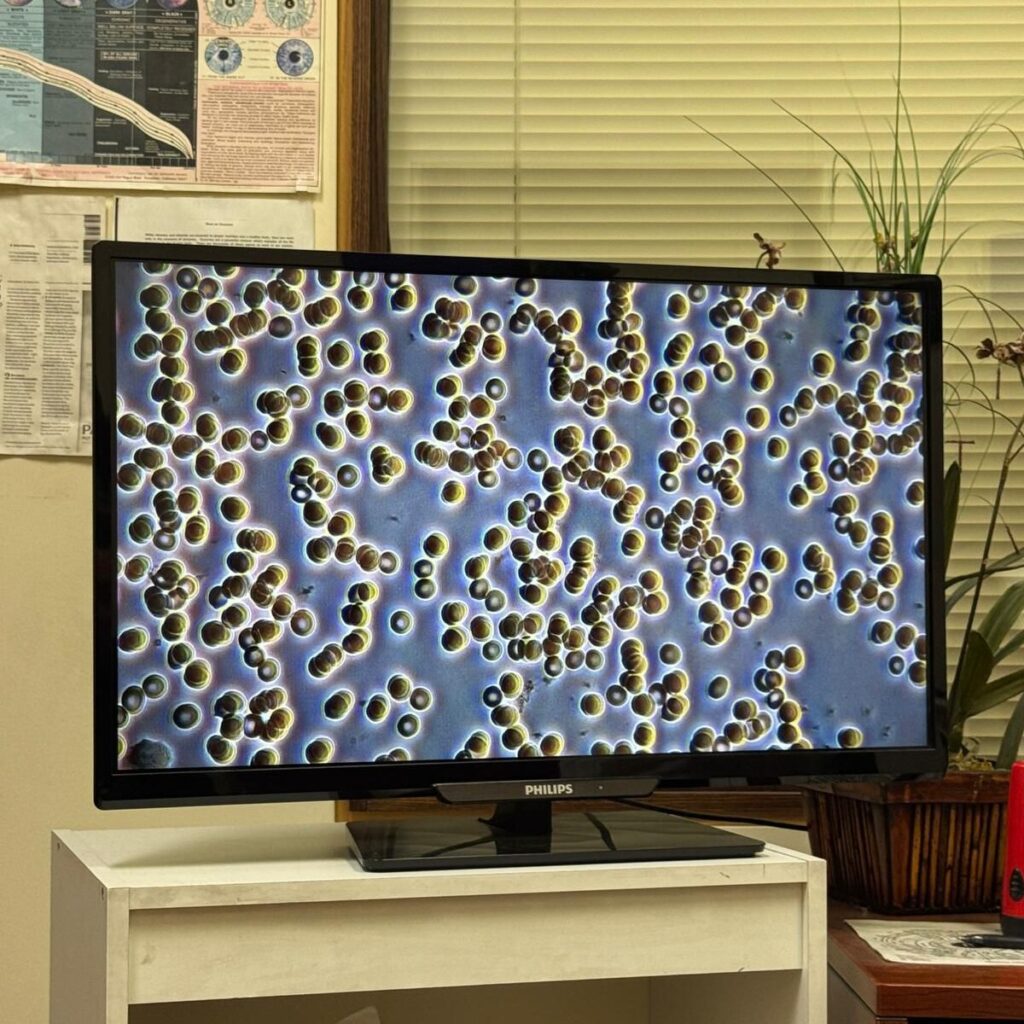
Microscopic images of red blood cells (erythrocytes) can visually demonstrate how sensitively the body responds to internal and external conditions.
Erythrocytes are responsible for transporting oxygen. Their shape, flexibility, and oxygen-carrying capacity are essential for effective cellular respiration.
The photographs accompanying this article capture the structure of red blood cells and their interactions under different conditions. These images remind us that health is not an abstract concept — it is a continuous biological process occurring at the microscopic level every second.
Our Approach
At Unique Therapeutics, we follow a simple principle:
Health begins at the cellular level.
Our approach is therefore focused directly on supporting:
- cellular energy,
- mitochondrial function,
- immune system balance,
- regulation through the Endocannabinoid System.
We concentrate on the development and application of advanced nano-formulations designed to enhance bioavailability and improve the effectiveness of active compounds at the cellular level.
Our goal is not merely to address symptoms, but to support the body’s natural regulatory mechanisms where health truly originates — in the cell.
The Future of Medicine Is Cellular
Modern science increasingly confirms that:
- metabolic balance,
- high-quality mitochondrial function,
- stable cellular communication,
- and proper immune regulation
are fundamental factors in long-term health.
Supporting cells means supporting life.
And that is exactly where our work is focused.